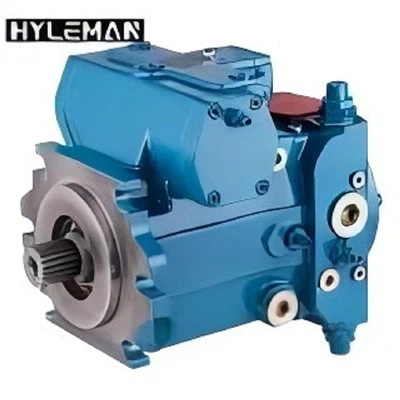
Hey there! As a supplier of Vickers Piston Pumps, I often get asked about the power consumption of these pumps. It's a crucial topic, especially for those looking to optimize their hydraulic systems and cut down on energy costs. So, let's dive right in and explore what affects the power consumption of a Vickers Piston Pump.
Understanding the Basics of Vickers Piston Pumps
First off, Vickers Piston Pumps are known for their high - performance and reliability in hydraulic applications. They work by using pistons to create pressure and move fluid through the system. The power consumption of these pumps depends on several factors, including the pump's displacement, operating pressure, and flow rate.
Displacement
The displacement of a Vickers Piston Pump refers to the volume of fluid that the pump can move in one revolution. A pump with a larger displacement will generally consume more power because it moves more fluid per revolution. For example, if you have a pump with a high - displacement rating, it will need more energy to push that larger volume of fluid through the system.
Operating Pressure
Operating pressure is another key factor. The higher the pressure the pump needs to generate, the more power it will consume. When a Vickers Piston Pump is working against a high - pressure load, it has to work harder, which means it uses more energy. Think of it like trying to push a heavy object; the heavier the object (higher pressure), the more effort (power) you need.
Flow Rate
Flow rate is the volume of fluid that the pump delivers per unit of time. A higher flow rate requires more power. If you need a large amount of fluid to be moved quickly through the system, the pump has to work faster and harder, thus consuming more power.
Calculating Power Consumption
The power consumption of a Vickers Piston Pump can be calculated using the following formula:
Power (in kilowatts) = (Pressure (in bar) × Flow rate (in liters per minute)) / (600 × Efficiency)
Let's break this down a bit. The pressure is the force per unit area that the pump needs to generate. The flow rate is how much fluid the pump is moving. The efficiency factor takes into account any losses in the pump, such as mechanical losses and leakage.
For example, if a Vickers Piston Pump is operating at a pressure of 200 bar, a flow rate of 50 liters per minute, and has an efficiency of 0.9, the power consumption would be:
Power = (200 × 50) / (600 × 0.9) ≈ 18.52 kilowatts


Real - World Examples
Let's look at some real - world scenarios to better understand power consumption. Suppose you're using a Vickers Piston Pump in a manufacturing plant for a hydraulic press. The press requires a high - pressure operation to form metal parts. In this case, the pump will need to generate a significant amount of pressure, which means it will consume more power.
On the other hand, if you're using the pump in a less demanding application, like a small - scale automated system where the pressure and flow rate requirements are lower, the power consumption will be much less.
Comparing with Other Pumps
It's also interesting to compare the power consumption of Vickers Piston Pumps with other types of pumps. For instance, the Pgp/Pgm315 Type Cast Iron Gear Pump&Motor has a different power consumption profile. Gear pumps generally have a lower efficiency compared to piston pumps, especially at high pressures. This means that for the same pressure and flow rate, a gear pump might consume more power.
Another example is the R902408312p A4vsg125 Eo1/30r - Ppb10K010n Axial Piston Pumps. These axial piston pumps are also designed for high - performance applications. However, their power consumption characteristics can vary depending on the specific model and operating conditions.
The Rexroth A22vg Series Piston Pump A22vg45 is another competitor in the market. It has its own set of features and power consumption patterns. When choosing between different pumps, it's important to consider the power consumption along with other factors like cost, reliability, and maintenance requirements.
Tips to Reduce Power Consumption
If you're looking to reduce the power consumption of your Vickers Piston Pump, here are some tips:
- Optimize the System Design: Make sure the hydraulic system is designed to minimize pressure losses. This can be achieved by using the right - sized pipes, fittings, and valves.
- Maintain the Pump: Regular maintenance, such as changing the oil, checking for leaks, and replacing worn - out parts, can improve the pump's efficiency and reduce power consumption.
- Use Variable - Displacement Pumps: These pumps can adjust their displacement based on the system's requirements, which can save a significant amount of power.
Conclusion
In conclusion, the power consumption of a Vickers Piston Pump is influenced by factors like displacement, operating pressure, and flow rate. By understanding these factors and taking steps to optimize the system, you can reduce power consumption and save on energy costs.
If you're in the market for a Vickers Piston Pump or have any questions about power consumption, feel free to reach out. We're here to help you find the right pump for your needs and ensure that you get the most efficient operation possible.
References
- Hydraulic Pump Handbook
- Vickers Piston Pump Technical Manuals