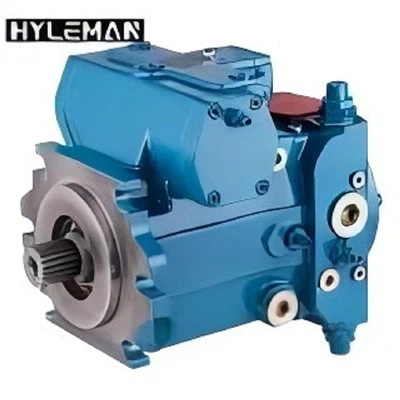
What is the power consumption of a single piston pump?
As a supplier of single piston pumps, I often encounter inquiries from customers regarding the power consumption of these pumps. Understanding the power consumption of a single piston pump is crucial for both the efficient operation of the equipment and cost - effectiveness. In this blog, I will delve into the factors that influence the power consumption of a single piston pump and provide some insights to help you make informed decisions.
Factors Affecting Power Consumption
1. Pressure Requirements
The pressure at which the single piston pump operates is one of the most significant factors affecting power consumption. According to the basic hydraulic power formula (P = \frac{\Delta p\times Q}{60}), where (P) is power in kilowatts, (\Delta p) is the pressure difference in bars, and (Q) is the flow rate in liters per minute. As the pressure requirement increases, the power needed to drive the pump also increases proportionally. For example, if you need to pump a fluid at a higher pressure to overcome resistance in a long pipeline or to operate a high - pressure hydraulic system, the pump will consume more power.
2. Flow Rate
Flow rate refers to the volume of fluid that the pump can deliver per unit of time. A higher flow rate generally means more work is being done by the pump in a given period, which in turn leads to higher power consumption. If your application requires a large amount of fluid to be transferred quickly, such as in large - scale industrial processes, the pump will need to operate at a higher flow rate, and thus, consume more power.
3. Pump Efficiency
The efficiency of a single piston pump plays a vital role in determining its power consumption. No pump is 100% efficient; there are always losses due to factors like mechanical friction, leakage, and fluid viscosity. A more efficient pump will convert a higher percentage of the input power into useful work, resulting in lower power consumption. When selecting a single piston pump, it is essential to consider its efficiency rating. High - efficiency pumps may have a higher initial cost, but they can save significant amounts of energy in the long run.


4. Fluid Properties
The properties of the fluid being pumped, such as viscosity, density, and temperature, can also impact power consumption. Viscous fluids require more energy to be pumped because they offer more resistance to flow. For example, pumping a thick oil will consume more power compared to pumping water. Similarly, the density of the fluid affects the power needed to move it. Higher - density fluids require more energy to be lifted or transported. Temperature can also influence fluid viscosity and density, thereby affecting power consumption.
Calculating Power Consumption
To calculate the power consumption of a single piston pump, we can use the following steps:
- Determine the pressure difference (\Delta p) across the pump. This is the difference between the discharge pressure and the suction pressure.
- Measure or estimate the flow rate (Q) of the pump. This can be done using flow meters or by referring to the pump's specifications.
- Consider the pump efficiency (\eta). The actual power input (P_{in}) to the pump can be calculated using the formula (P_{in}=\frac{\Delta p\times Q}{60\times\eta}).
For example, if a single piston pump has a pressure difference of 20 bars, a flow rate of 30 L/min, and an efficiency of 0.8, the power consumption can be calculated as follows:
First, use the basic power formula without considering efficiency: (P=\frac{\Delta p\times Q}{60}=\frac{20\times30}{60}= 10) kW
Then, considering the efficiency: (P_{in}=\frac{10}{0.8}=12.5) kW
Impact of Power Consumption on Applications
In industrial applications, high power consumption of single piston pumps can lead to increased operating costs. For manufacturing plants, where pumps are used continuously, even a small increase in power consumption can result in substantial financial losses over time. On the other hand, in applications where power supply is limited, such as in remote areas or mobile equipment, minimizing power consumption is essential to ensure the proper functioning of the pump and the overall system.
Our Product Offerings
As a supplier, we offer a wide range of single piston pumps to meet different power consumption requirements. For example, our Yuken A70 - Series Piston Pumps A70 - F - R - 05 - H - K - 60 are designed to provide high - efficiency operation with relatively low power consumption. These pumps are suitable for various industrial applications where precise pressure and flow control are required.
Our Hydraulic Ksd Series Plunger Pumps are another excellent option. They are engineered to handle high - pressure applications while maintaining good energy efficiency. These pumps are often used in heavy - duty industries such as mining and construction.
If you are looking for a pump that can operate in environments where electricity is not readily available, our Air Operated Piston Pump is a great choice. It uses compressed air as a power source and can be a cost - effective solution for certain applications.
Contact for Purchase and Consultation
If you are interested in our single piston pumps or have any questions about power consumption, please feel free to contact us. We have a team of experts who can provide you with detailed information, help you select the most suitable pump for your application, and offer advice on reducing power consumption. Whether you are a small - scale business or a large industrial enterprise, we are committed to providing you with high - quality products and services.
References
- Fluid Power Handbook, various authors.
- Hydraulic Pump Technology Manual, industry - specific publishers.